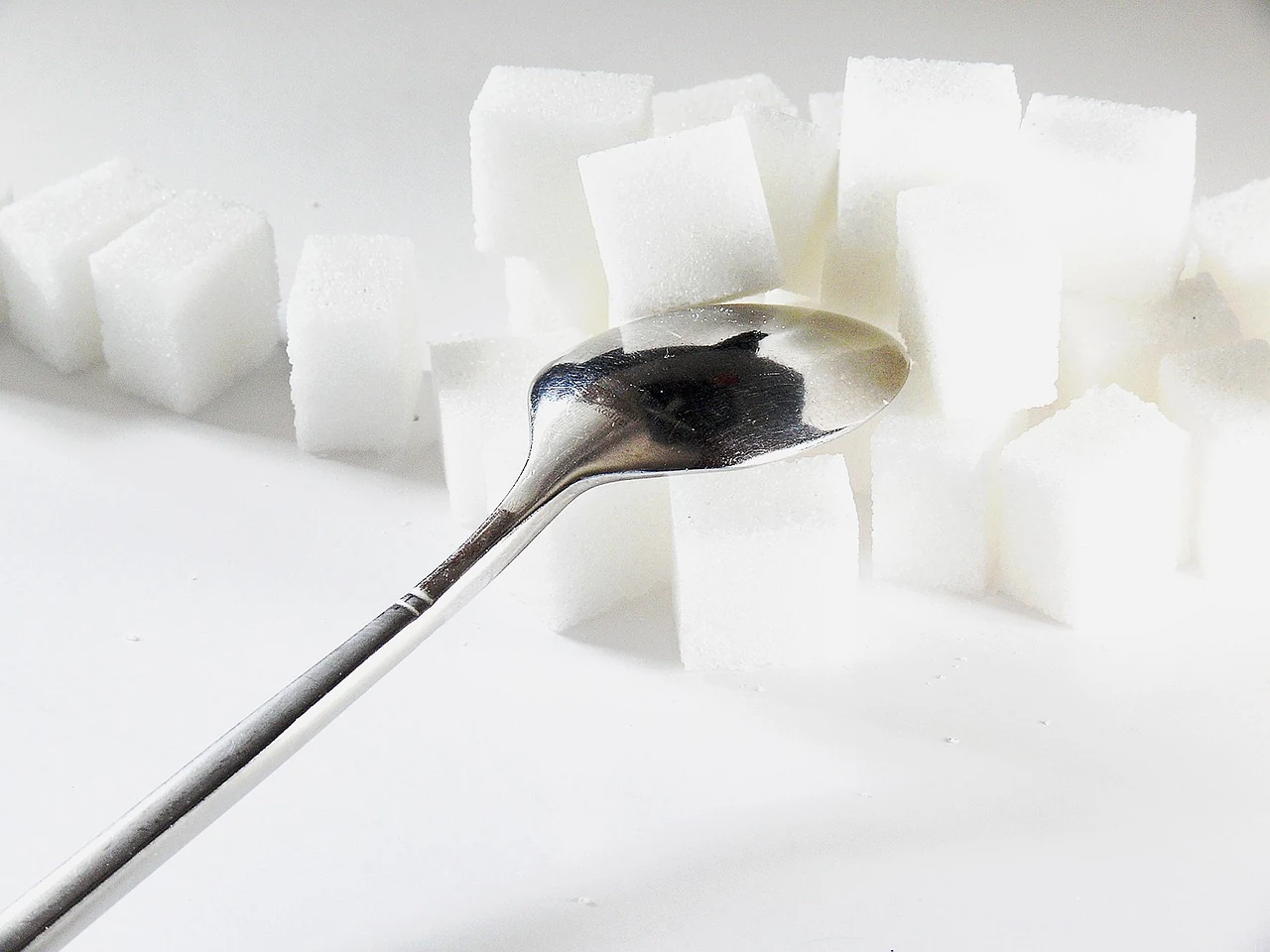

Sugar is not a single product but a group of simple carbohydrates: monosaccharides (glucose, fructose, galactose) and disaccharides (sucrose, maltose, lactose). In everyday language, sugar usually means sucrose (produced from beet and cane). Below is information about free sugars, the origin of the numbers in the guidelines, and how to find sugar where it is not visible.
Free and natural sugars: the boundary is not where it seems
The division is not based on the chemistry of the substance but on the form of intake. Free sugars are mono- and disaccharides that a manufacturer, cook, or the person themselves adds to food and drinks: sucrose, fructose, glucose. They also include sugars naturally present in honey, syrups, fruit juices, and juice concentrates. Honey is not different in status from added sugar, and most fruit juices, even without added sugar, contain a significant amount of free sugars.
Sugars naturally present in milk, fruits, and vegetables are not considered free, and their consumption does not need to be reduced. On a label, they are included in the 'total sugars' figure together with free sugars.
Guidelines: 10% of energy in WHO and stricter 5%
WHO recommends keeping free sugars below 10% of daily energy. For a person with normal body weight and a 2000 kcal diet, this is 50 g, or approximately 12 level teaspoons per day. Reducing to 5% or less may provide additional health benefits.
Carbohydrates should provide approximately 45–75% of daily energy, and WHO recommends obtaining them mainly from whole grains, vegetables, fruits, and legumes. There is also a reference for adults and children over 10 years: at least 400 g of fruits and vegetables per day and 25 g of dietary fiber.
The guideline based specifically on 5% gives concrete limits: for adults — no more than 30 g of free sugars per day (about 7 cubes), for children 7–10 years — 24 g, 4–6 years — 19 g, 2–3 years — 14 g, for one-year-olds — 10 g. For children under one year, there is no threshold figure, but sugar is not added to food or drinks.
Where sugar hides
- Sweet drinks: carbonated water, juice-containing drinks, smoothies.
- Breakfast cereals.
- Cookies, pastries, sweets, chocolate.
- Flavored yogurts.
A can of sweet carbonated water can contain up to 9 sugar cubes — more than the daily limit for an adult.
Label: the line 'of which sugars'
In the label 'carbohydrates, of which sugars', all sugars are combined: free, milk, and fruit sugars. To compare packages, thresholds apply: more than 22.5 g of total sugars per 100 g — high content, 5 g or less — low, the interval between them — medium. Regular yogurt may contain up to 8 g of sugar per serving, and all of it is milk sugar; an apple contains about 11 g depending on variety and ripeness, but these are not free sugars until the fruit becomes juice or puree.
If the label only states 'carbohydrates' without specifying 'of which sugars', the figure includes starch and is not suitable for estimating sugar — then the ingredient list is useful.
The ingredient list is more informative than the number: ingredients are listed in descending order of quantity, and sugar near the beginning of the list means a lot of free sugars. White sugar is purified crystallized sucrose from sugar beet (31% of world production) or cane (69%); brown sugar is white sugar mixed with molasses. One should look not only for the word 'sugar': the list may include cane sugar, honey, corn syrup, fructose, sucrose, glucose, fruit juice concentrate, nectars.
Teeth and weight: what the data show
Excessive sugar consumption can lead to weight gain and tooth decay. Unhealthy diet is a significant risk factor for diabetes, heart disease, stroke, and cancer (WHO). WHO specifically notes: free sugars should be reduced without replacement with non-sugar sweeteners — acesulfame K, aspartame, saccharin, sucralose, stevia.
Sweets without extremes
The frequency and amount of sweet foods and drinks should be as low as possible, and this is the framework within which the daily figure remains manageable.
Sugar itself is not a reason to call an ambulance; 103/112 — for a life-threatening condition, including signs of stroke or heart attack.
WHO recommends limiting free sugars throughout life.
This material is for reference: it does not replace a doctor's consultation.
Sources
Update history
This content is for reference and does not replace a doctor's consultation. Medical disclaimer