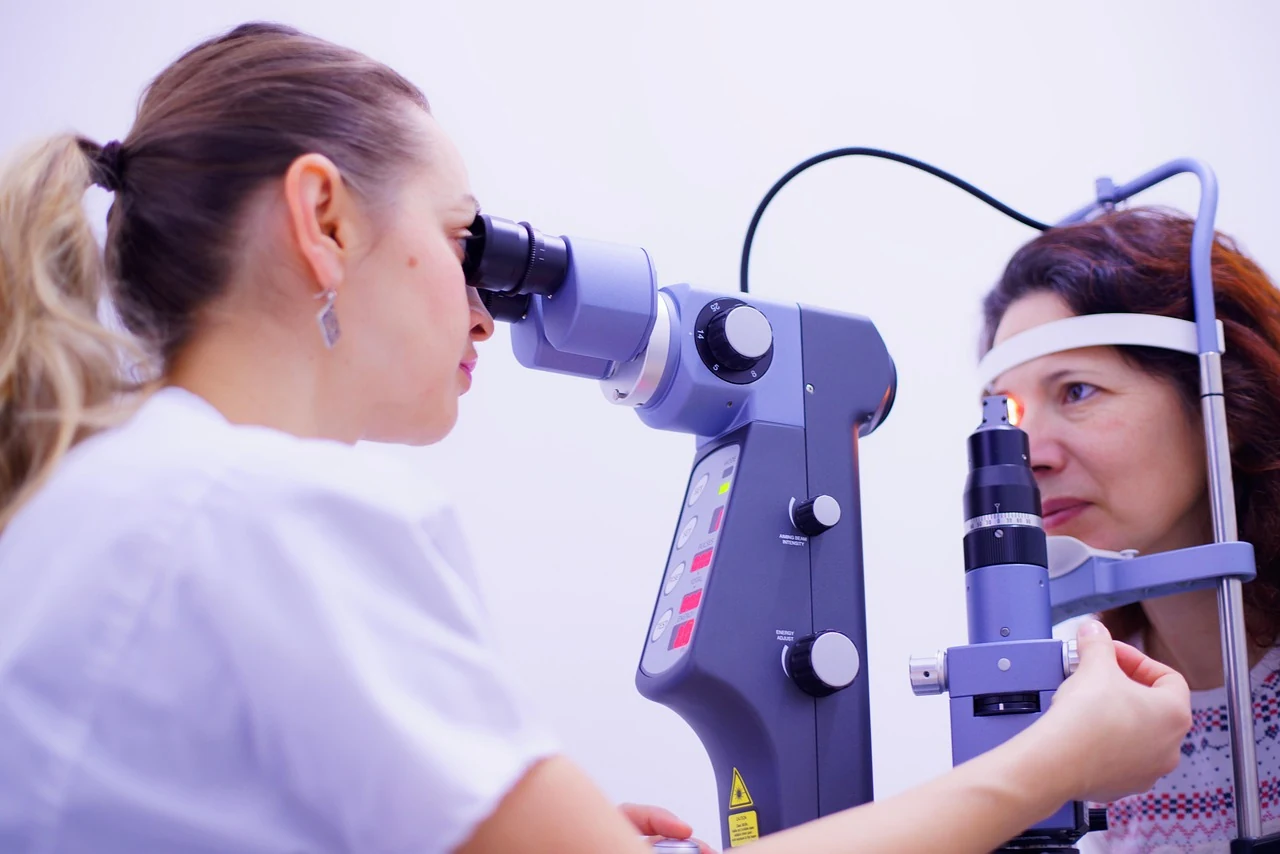

An eye exam, that is, an appointment with a doctor who deals with eye diseases, consists of several different checks. Some eye diseases develop slowly and without pain, so they are often detected during a routine appointment.
What Is Checked During an Appointment
The best-known part of the appointment is a visual acuity test, that is, the eye's ability to distinguish two points at a minimal distance. It is determined using charts, and each eye is checked separately, because visual acuity may differ between the eyes. A value of one, that is, one hundred percent, is considered normal; acuity below 0.9 is considered reduced.
Next come the individual tests used in a vision exam. Each of them checks its own part of the eye.
- Red reflex test: a device that magnifies and illuminates the image is shone into the eye; normally red light is reflected from the eye, while white light may be a sign of a problem.
- Pupillary reflex test: each eye is illuminated separately and the doctor watches how the pupils react to light.
- Snellen and LogMAR charts: rows of letters, numbers, or pictures get smaller, and the child reads or points to what they see from a certain distance; for young children, pictures are used instead of letters.
- Eight-direction eye movement test: an object is moved up, down, left, right, and midway between these points to assess how the eye muscles work.
- Refraction test: it shows whether glasses are needed and which lenses exactly; before it, drops that dilate the pupils may be instilled so that the back of the eye can be seen better.
Color vision is checked separately when there is a suspicion of a problem, most often using Ishihara plates: on an image made of dots of two colors, a letter or number must be recognized.
Such an exam detects more than reduced acuity. It reveals myopia, when distant objects are blurry, hyperopia, when distant objects are seen clearly but near objects are blurry, and astigmatism, when the front clear membrane of the eye has an irregular curvature. It also detects strabismus, when the eyes point in different directions, "lazy eye," that is, amblyopia, when the vision of one eye does not develop properly, and congenital cataract—clouding of the lens present from birth.
Pupil Dilation: Why and What Happens After
The pupils are the black dots in the center of the eyes, and they should constrict in response to light. Before a refraction test, a person may be given drops that dilate the pupils: through a wide pupil, the back of the eye can be seen more clearly.
How Often to Have an Exam
The eyes are examined at least once every two years. Glaucoma, which is called the silent thief of sight, is most often detected during a routine exam and often before symptoms appear. If the risk is higher, exams are done more often.
The risk is higher for people over 50 years of age; for those whose brother, sister, or one of their parents has glaucoma; for people with myopia, hyperopia, or diabetes. It is also more common in people of African, Caribbean, and Asian descent. Among the leading causes of vision loss worldwide are refractive errors, cataract, diabetic eye disease, glaucoma, and age-related macular degeneration; most people with reduced vision are over 50 years of age.
Worldwide, at least 2.2 billion people live with vision impairment, and in at least a billion of them it could have been prevented or has not yet been brought under control. Timely access to quality care reduces some of these consequences.
Exams in Children
Newborns and young children are offered routine vision checks to detect problems as early as possible; screening that detects reduced vision in one or both eyes is performed at around 4–5 years of age.
A child may not understand that they see poorly. Signs of a problem include eyes that point in different directions, frequent complaints of headache, difficulty reading, clumsiness in active games, frequent eye rubbing, and a habit of sitting very close to the TV.
When Not to Wait for a Routine Exam
Eye redness without pain, without changes in vision, and without feeling unwell usually resolves within a few days. If there is sticky discharge, if the redness lasts longer than a few days, or if a red spot appears on the white of the eye, see a doctor as soon as possible; the same applies to a child under two years of age.
Call 103 (emergency medical services) or 112 immediately if symptoms of glaucoma appear suddenly: severe eye pain, redness, rainbow-colored halos around bright light, nausea and vomiting, headache. The same applies to eye redness with changes in vision, when it is painful to look at light, when the eye is very dark red, when a foreign body has gotten into the eye or it has been damaged by a chemical substance, or when one pupil is larger than the other.
This material is for reference and does not replace consultation with a doctor.
Sources
Update history
This content is for reference and does not replace a doctor's consultation. Medical disclaimer