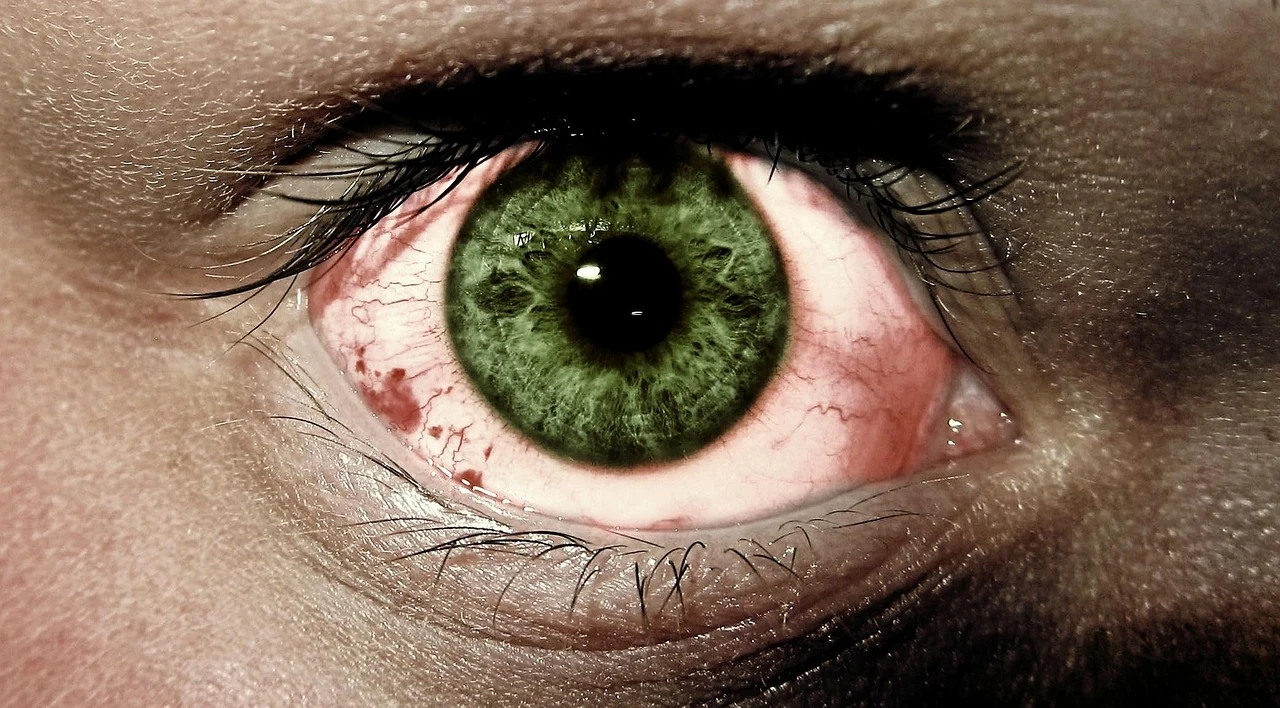

Red eye is not a diagnosis but a symptom. Most often it is caused by conjunctivitis or dryness, but sometimes redness signals a condition that cannot wait. Below is a short guide: causes, types of conjunctivitis, contagiousness, and the moment when you cannot delay.
What lies behind the redness
There are many causes, and they are not equivalent. Red eye usually resolves on its own within a few days, but sometimes it hides a more serious problem — which is why self-diagnosis does not work: similar symptoms have different causes.
What it looks like in practice. A bright red patch on the white of the eye — a broken blood vessel. Burning or a gritty sensation and sticky eyes — conjunctivitis. Painful, blurry, or watery eyes — dry eyes. Itchy, painful, or red crusts on the eyelids — blepharitis. Episcleritis also occurs: it runs like conjunctivitis but without discharge or tearing. There are also misdirected eyelashes and eyelid problems.
Conjunctivitis: three faces
Conjunctivitis is inflammation of the mucous membrane of the eye caused by infection or allergy. It often resolves within a couple of weeks even without treatment, but not always.
- Infectious (viral or bacterial) — discharge that glues the eyelashes together; in adults, 85% of cases are caused by adenoviruses and only 15% by bacteria; in children, both occur equally often.
- Adenoviral — transmitted by airborne droplets and causes outbreaks in children's groups; enteroviral and herpetic forms also occur.
- Allergic — itching, tearing, eyelid swelling, sensitivity to light; the eyes are red and watery but not contagious.
Acute and chronic courses are distinguished separately, as is chlamydial conjunctivitis. The causative agents of infectious conjunctivitis can also include streptococci, staphylococci, chlamydia, viruses, and fungi; the chronic form is driven by irritants that act for a long time — dust, smoke, chemical impurities in the air. Some sexually transmitted infections also cause conjunctivitis, and this type takes longer to resolve; chlamydia and gonococci are specifically dangerous due to complications: keratitis, corneal ulcer, its perforation, blindness. Gonococcal conjunctivitis occurs in newborns during passage through the mother's birth canal. The remaining cases, as a rule, do not cause serious consequences.
Contagiousness: who transmits and how
Infectious conjunctivitis is contagious and easily passes from person to person through direct contact. Sticky purulent discharge is a marker of contagiousness; redness with a gritty sensation is also usually contagious. Allergic conjunctivitis is not.
It is transmitted through hands, towels, pillowcases, and shared objects. Epidemic Koch-Weeks conjunctivitis spreads through the patient's contaminated hands and infected objects — mainly in summer among children in hot-climate countries.
Isolation for the entire period is not necessary if the person feels well.
Lenses and red eye
Lenses are a separate risk point. Red eye in a person who wears lenses is a reason to seek emergency care: it may be an eye infection. If a rash on the eyelids is added to the redness, the cause may be an allergy to the lenses themselves.
A warning sign is changes in vision: wavy lines, flashes, loss of vision.
When to see a doctor
Routinely: red eyes with sticky discharge; a child under 2 years old with a red eye; red spots in the eye or problems with the eyelids or eyelashes lasting more than a few days; conjunctivitis that does not resolve within a week; any concern about the eyes.
Urgently: a very painful and red eye; a red eye in an infant under 28 days old; a red eye while wearing lenses.
Call emergency services at 103 or 112 if the red eye is accompanied by: pain from light; severe headache and nausea; a very dark red color of the eye; eye injury or a foreign body in it; chemical fluid getting into the eye; pupils of different sizes.
How to reduce risk and what the doctor determines
If the cause is unclear, the doctor refers the patient to an ophthalmologist for examination.
Risks that can be influenced: contact with infected objects, shared towels and pillowcases, lenses during inflammation, irritants — dust, smoke, chemical impurities in the air, allergens.
This material is for reference and does not replace a doctor's consultation — an eye is too precious a thing for guesswork.
Sources
Update history
This content is for reference and does not replace a doctor's consultation. Medical disclaimer