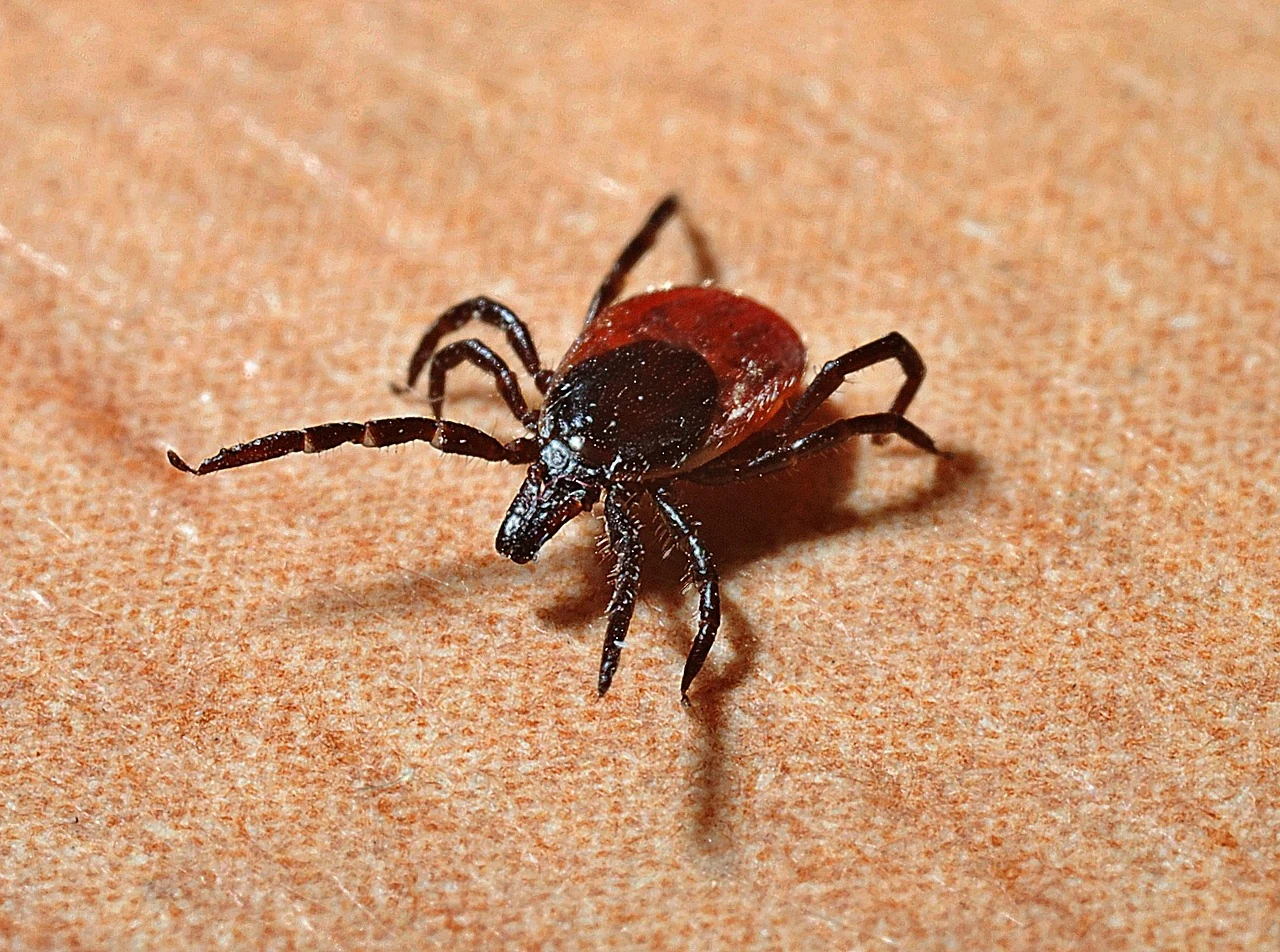

Ticks live in forests, tall grass, and city parks, and after a bite from an infected tick a person can develop Lyme disease or tick-borne encephalitis. These are two different infections — bacterial and viral — and the consequences depend on how quickly a person notices the symptoms. Below: signs, diagnosis, and prevention.
What ticks in Ukraine carry
Ticks transmit the causative agents of Lyme disease — bacteria of the Borrelia burgdorferi sensu lato complex — and the tick-borne encephalitis virus. The infection rate of ticks with borrelia in different regions of Ukraine ranges from 3% to 25%. Between 2000 and 2023, 45,371 cases of Lyme disease were registered in the country, most of them in cities. Between 1955 and 2008, 569 cases of tick-borne encephalitis were registered in Ukraine. Certain areas of Crimea, Volyn Oblast, and Yavoriv Raion of Lviv Oblast are endemic for tick-borne encephalitis.
Erythema migrans: a rash around the bite
In some people, the first sign of Lyme disease is a round or oval rash around the bite site. It can appear within three months, but usually appears after 1–4 weeks and lasts several weeks. The center may be darker or lighter than the edges, and the rash itself gradually expands. It is usually not hot and does not itch, may be flat or slightly raised, and on light skin looks pink, red, or purple, sometimes like a dartboard. On brown and black skin it is harder to notice: it resembles a bruise.
Symptoms of Lyme disease
A few days or weeks after a bite from an infected tick, some people develop flu-like symptoms: fever, feeling hot or cold, chills, headache, muscle and joint pain, fatigue, and loss of energy. If the disease is not treated in time, more severe symptoms may appear months or years later: joint pain and swelling, nervous system disorders in the form of pain or numbness, heart problems, and difficulty with memory and concentration.
Tick-borne encephalitis
This is a viral infection that predominantly affects the central nervous system and can lead to disability and, in some cases, death. The fatality rate for the European form is about 2%, and for the Far Eastern form up to 20%. About 13,000 severe cases requiring hospitalization are registered worldwide each year. The virus is transmitted by Ixodes ricinus and Ixodes persulcatus ticks; the disease is milder in Europe than in the east of its range.
When to see a doctor after a bite
You should see a family doctor without delay if within the last three months you were bitten by a tick or were in an area where infected ticks are possible, and you have developed flu-like symptoms (fever, chills, headache, muscle pain) or a round or oval rash. At the appointment, tell the doctor that you were in a forest or grassy areas. The doctor will ask about symptoms, the rash, and known bites. Diagnosing Lyme disease is not easy: its manifestations resemble other conditions, and a rash is not always present. There are two types of blood tests, but in the early stage they are not always accurate, so tests are repeated if needed.
In a small number of people, fatigue, pain, and loss of energy remain after treatment and can last for years; these manifestations are compared with fibromyalgia and chronic fatigue syndrome. Why this happens in some people and not others is unknown, so there is no agreed approach. If symptoms return or do not resolve after treatment, see a doctor.
Seek a doctor immediately when a condition is life-threatening: stroke, heart attack, severe injury. Call 103 or 112.
Preventing bites
- Wear closed clothing with trousers tucked into socks.
- Wear light-colored clothing, on which a tick is easier to spot.
- Walk along cleared paths.
- A bite is not always painful, so after a walk check clothing, skin, children, and animals.
This material is for reference and does not replace a doctor's consultation.
Sources
Update history
This content is for reference and does not replace a doctor's consultation. Medical disclaimer